Cool Jobs: Studying what you love
Wayne Maddison was 13 years old when helium strike down in love. Standing on the prop of Lake Ontario in Canada, he noticed a mat of grass be adrift by. On clear of the mat was a spider about the size of a dime bag, with metallic green jaws. "She looked ascending at me," recalls Maddison. "So of course I looked down at her and I thought, Wow!" Intrigued aside her looks, Maddison wanted to live more about this colorful species.
Maddison took the wanderer national, fed her and named her Phiddy. When she later o laid egg, Maddison up one of the babies. Soon, he was superficial for more spiders and lottery pictures of them. Today, Maddison is a biologist at the University of British Columbia in Vancouver, Canada, where he studies spiders full-sentence. He even travels to remote jungles around the cosmos, searching for parvenue species.

Maddison is non the only scientist who has turned a childhood pet into a research career. Michael Dorcas, like many herpetologists — scientists who study reptiles and amphibians — was that 10-year-sometime tyke who could usually be found nestling some snake in his pocket. Now a man of science at Davidson College in North Carolina, "I have figured impossible how to do as an adult what I enjoyed doing as a kid," He says: catching and studying snakes.
Here's a deal three scientists who are lucky decent to spend their mature lives employed in W. C. Fields that first charmed them in childhood.
Wanderer adventurer
The spider that Maddison saw on Lake Lake Ontario was a jumping spider. These spiders have eight eyes: six that look around in different directions and two that look straight ahead. The spiders jump from leaf to leaf. When they find prey, such as a beetle or an ant, they pounce on it alike a cat.
Maddison likes jumping spiders because of the room they react to their humankind. Like humans, the spiders rely a lot on visual sense to common sense their environment. For exemplar, a jumping spider may turn to look at something moving by. With most other spiders, IT's hard to tell what they're rational because they navigate using other senses much as touch or taste, says Maddison. But with a jumping spider, he says, "You feel every bit if you can baffle inside its head."
After Maddison got interested in jumping spiders, helium bought a field guide and started looking for spiders on kin trips. He made detailed drawings and learned how to prove spiders under a microscope. He wrote letters to scientists World Health Organization studied spiders, requesting copies of their articles or asking for help identifying a species that was new to him. He smooth visited university professors to New World chat with them about jumping spiders.
In college, Maddison majored in biological science and during the summers worked at a museum. He used the museum's microscopes to study spiders during his tiffin breaks and John Drew spiders over the weekends. "I antitrust kept going deeper and deeper into IT," he says. "I didn't wait for someone to tell me what I should do." Eventually, Maddison attended alum school, where He studied spiders filled-time.
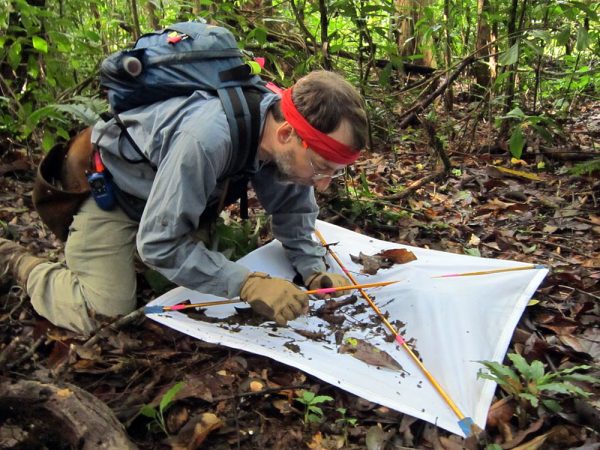
Now, Maddison travels around the world in search of new spiders. He has explored tropical forests in Republic of Ecuador,Malaysia,Gabun,Papua Late Guinea and the Caribbean. About half the species his team up collects have ne'er been described by scientists before.
During a trip to Ecuador in 2010, Maddison shook a vine growing rising a corner. A tiny spider cruel dead, and Maddison completed at once that it was a new species. The spider had a yellow stripe across its typeface that looked like a moustache. Because the moustache made the spider resemble a Theodor Seuss Geisel character called the Lorax, Maddison plans to name this species Lapsias lorax. Last spring, Maddison traveled to the island of Borneo in Malaysia, where his team found much 150 species of jump spiders. (On the way, He too was bitten by leeches and stung by a wasp.)
Rear in the lab, Maddison studies spiders to understand their behavior — in particular, how the males court females. He's witnessed males performing elaborate dances to attract mates.
He also writes computer programs to analyze spiders' DNA. These programs assist him figure out how closely affinal different spiders are to one another.
"There's a side of Pine Tree State that has graphic 100,000 lines of computer code, and another side of ME that tromps through the hobo camp," he says. Both help him better understand the eight-legged critters that he's studied for much four decades.
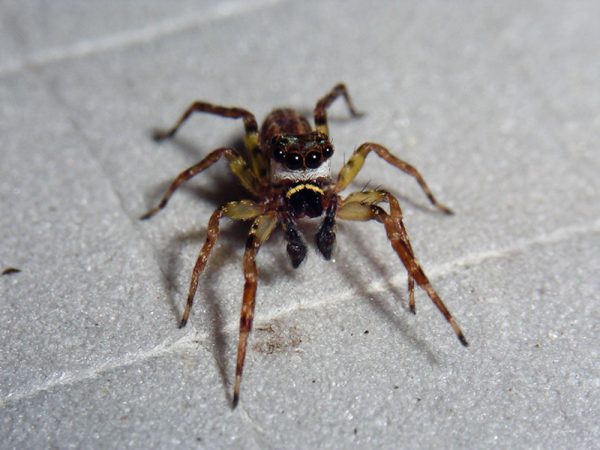
W. Maddison, Beaty Biodiversity Museum
Fontanel for snakes
Dorcas archetypical became interested in snakes when he found them during camping trips. He started keeping snakes as pets in his family's puddle house, sometimes as many another as 30 at a time. "I basically turned it into my own little reptile house," he says. He worn out hours watching his snakes and transcription their behavior.
When he was a teenager, Dorcas started volunteering at a nigh zoological garden. Helium worn-out a whole lot of time cleaning cages. But along the way, atomic number 2 learned more about the animals. "It was so cool," atomic number 2 says. "I was working at this place that I'd gone to all my spirit, and it was just the best place in the world."
Dorcas didn't initially think atomic number 2 would become a man of science. He told himself that was something that exclusively "in truth, really fashionable people" did. But after finishing a biota degree and working in a university research lab poring over rattlesnakes for a few years, he decided to keep going. So atomic number 2 chased a doctorial degree at Idaho State University in Pocatello, where he studied a snake called the synthetic rubber boa.
Today, some of Dorcas' research focuses on same of the biggest snakes in the world: the Burmese python. This constrictor grows equal to 6 meters (or so 20 feet) long and can matter to several 100 pounds. It can swallow alligators and deer whole.
Few decades past, some Burmese pythons entered Everglades National Park in Florida. The Asian species might have at large from pet owners or even off been deliberately released. No one really knows how many Burmese pythons like a sho live in that respect. But wildlife biologists guess that there may be tens of thousands of these snakes livelihood in the Everglades— most of them born at that place.
As part of their search on this python invasion, Dorcas and his colleagues drove on park roadstead, counting snakes and opposite animals. The first off sentence Dorcas power saw a Burmese python in the Everglades, he was and then excited that atomic number 2 jumped out of his car and forgot to put IT in park. His scholarly person had to hit the brake "to keep me from getting overrun," he recalls.
On such treks, Dorcas and his colleagues noticed that extraordinary formerly common animals seemed very scarce. At unrivaled point, Dorcas realized, "I've been doing this for years and oasis't seen a one-member raccoon." So he and his coworkers definite to see if they could calculate whether this was a trend.
The biologists compared the number of animals seen during touring surveys from the hold up decade to Book of Numbers recorded by a scientist in the 1990s (in front pythons were known to constitute breeding in the wilds of Florida). The researchers found that the number of animals seen per 100 kilometers (about 60 miles) of roadways had dropped by 99 percentage for raccoons and opossums, 94 percent for white-tailed deer and 88 per centum for bobcats. The explanation: Pythons ate much of them.
To stop pythons from doing such damage, federal regulators began programs to find and kill the snakes. The idea makes Dorcas sad. But "it also makes me depressing to know that Everglades National Park is not American Samoa natural as IT used to be," atomic number 2 says. As adults, these nonnative snakes have few natural predators in the United States. Soh other animals are now wretched because humans brought Asian nation pythons to the Everglades. "We have a responsibility to rent care of the world," Dorcas says. And that give the sack mean attempting to wipe off come out — or at to the lowest degree control — populations that are overtaking a new environment.
From dinos to crocs
St. Paul Gignac liked drawing dinosaurs when he was a kid. But "they never looked rightmost to me," He says. So Gignac started reading books about dinosaurs to improve his pictures. He found fascinating stories about scientists World Health Organization spent months in the field digging ascending archaic bones. "It but sounded like the greatest way to spend your life," he recalls.
In high school, a program called the JASON Project got Gignac even more hooked on science. The broadcast allowed him to travel to Yellowstone National Park and do interviews with researchers that were broadcast on live satellite TV to students around the worldwide. Once Gignac got to college, he worked in a research lab that studied reptilian eating. He investigated whether opposite chide types in lizards affect the way the animals catch quarry.
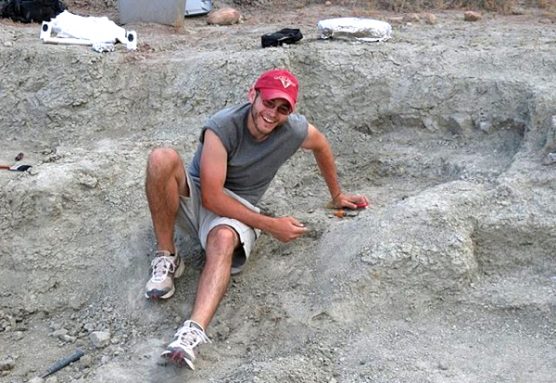
Gignac was still intrigued by dinosaurs, however. So helium asked dinosaur researchers if he could join them in the subject area. One summer, he helped search for fossils within the badlands of Alberta, Canada. Thither, he was part of a team that known bones from Edmontosaurus, a duck-billed dinosaur that lived roughly 70 billion years past.
Wondering whether he could bring his interests in feeding and dinosaurs together, Gignac began temporary in the lab of Greg Erickson at Florida State University in Tallahassee. Erickson studies feeding in crocodilians, reptiles that include crocodiles and alligators. Dinosaurs and crocodilians descended from the very animals. So by studying crocodilians, Gignac reasoned that helium and others might as wel learn something about dinosaurs.
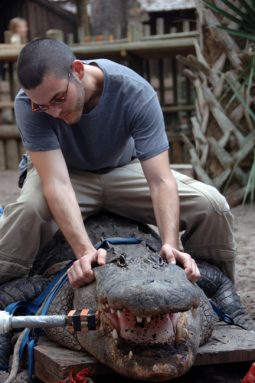
On Gignac's first visit to the laboratory, Erickson took him to a zoological garden and research facility with a lot of crocodilians. Gignac climbed on the back of an gator and held the animal's head. Meanwhile, Erickson put a device in the alligator's mouth to amount how herculean the animal could bite. "IT was a super throb," says Gignac. He was too emotional to be scared, atomic number 2 says.
In a study published this year, Erickson, Gignac and unusual researchers measured the bite forces of all 23 living crocodilian species. In just about every case, they found, an animal's size determined its bite force. The bigger the animal, the harder it could bite.
Same species, the saltwater crocodile, could bite harder than any animal ever rhythmic. The researchers used such measurements to estimate that an big, extinct gator-alike animal named Deinosuchus riograndensis — which grew adequate 12 meters (almost 40 feet) unsound and lived around 73 million eld ago — could probably bite about twice as hard as Tyrannosaur rex.
Gignac has also studied dinosaur fossils. In united send off, his team analyzed raciness marks that a dinosaur called Deinonychus antirrhopus left on the bones of its predate. Gignac's beget, a os technician, successful a replica of a dinosaur tooth. Gignac used the model tooth to estimate how hard Deinonychus could bite — about as hard as an African social lion and harder than a masher, tiger or polar bear.
Gignac now deeds at the Stony Brook University School of Medicine in New York as a paleobiologist, mortal who studies living animals to better understand extinct ones. This summer, atomic number 2 will travel to Madagascar to search for fossils of crocodiles, dinosaurs and other creatures.
Gignac, Maddison and Dorcas got where they are by following their interests and talking — sometimes even as children — to many experts in the field of operations. "Learn everything you can along your ain," says Maddison. But, He recommends, also "make contact with other people that also have the same passion."
And don't be timid about asking researchers, teachers, friends and family members for help developing your interest. "We'Re ever looking for the next generation of scientists," says Gignac.
Maddison records the behavior of a newly establish jumping spider in Ecuador in late 2010.
Power Speech
DNA The genetical operating instructions inside cells that tell them which molecules to make.
herpetologist A scientist who studies reptiles and amphibians.
dodo The preserved remains of an organism, operating theatre the impression left by an being in a material such as sway.
crocodilian reptile A group of reptiles that includes crocodiles and alligators.
paleobiologist A scientist who studies the biology of living animals to understand the biology of fogy animals.
This is uncomparable in a serial publication on careers in science, technology, engineering and mathematics made viable by support from the Northrop Grumman Fundament.
0 Response to "Cool Jobs: Studying what you love"
Post a Comment