What Kind of Management Personnel Do You Need to Start a Construction Company
 |
two. Organizing for Project Direction
2.1 What is Projection Management?
The direction of structure projects requires cognition of modern management as well every bit an understanding of the design and construction procedure. Construction projects have a specific ready of objectives and constraints such as a required fourth dimension frame for completion. While the relevant engineering, institutional arrangements or processes volition differ, the direction of such projects has much in common with the management of like types of projects in other specialty or applied science domains such as aerospace, pharmaceutical and energy developments.
Generally, project direction is distinguished from the general management of corporations by the mission-oriented nature of a projection. A project organization volition generally be terminated when the mission is accomplished. Co-ordinate to the Project Direction Institute, the subject of project management can be defined as follows: [1]
Project management is the art of directing and coordinating human and cloth resource throughout the life of a projection past using modernistic management techniques to achieve predetermined objectives of scope, price, time, quality and participation satisfaction.
By contrast, the general management of business and industrial corporations assumes a broader outlook with greater continuity of operations. Withal, in that location are sufficient similarities every bit well as differences betwixt the two so that modernistic management techniques developed for general management may be adjusted for project direction.
The basic ingredients for a projection direction framework [2] may be represented schematically in Effigy ii-1. A working knowledge of general management and familiarity with the special cognition domain related to the project are indispensable. Supporting disciplines such equally calculator science and determination science may also play an of import role. In fact, modern direction practices and various special knowledge domains have captivated diverse techniques or tools which were one time identified simply with the supporting disciplines. For example, computer-based information systems and decision support systems are at present common-identify tools for general management. Similarly, many operations research techniques such equally linear programming and network analysis are at present widely used in many knowledge or application domains. Hence, the representation in Effigy 2-1 reflects only the sources from which the project direction framework evolves.
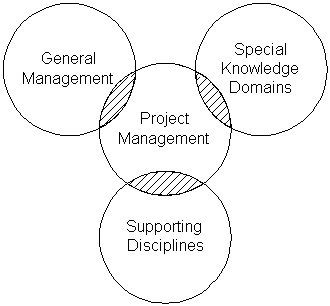
Effigy 2-1: Bones Ingredients in Project Management
Specifically, project management in construction encompasses a gear up of objectives which may be accomplished by implementing a serial of operations field of study to resource constraints. At that place are potential conflicts between the stated objectives with regard to scope, cost, time and quality, and the constraints imposed on human material and financial resources. These conflicts should be resolved at the onset of a project by making the necessary tradeoffs or creating new alternatives. Subsequently, the functions of project direction for construction generally include the post-obit:
- Specification of projection objectives and plans including delineation of telescopic, budgeting, scheduling, setting performance requirements, and selecting project participants.
- Maximization of efficient resources utilization through procurement of labor, materials and equipment according to the prescribed schedule and program.
- Implementation of diverse operations through proper coordination and control of planning, blueprint, estimating, contracting and construction in the entire process.
- Development of effective communications and mechanisms for resolving conflicts among the various participants.
- Project integration management to ensure that the various project elements are effectively coordinated.
- Project scope management to ensure that all the piece of work required (and only the required work) is included.
- Project time direction to provide an effective project schedule.
- Project price management to place needed resources and maintain budget control.
- Projection quality direction to ensure functional requirements are met.
- Projection human resource direction to development and effectively employ projection personnel.
- Project communications management to ensure effective internal and external communications.
- Project adventure management to analyze and mitigate potential risks.
- Project procurement management to obtain necessary resource from external sources.
2.2 Trends in Modernistic Direction
In contempo years, major developments in management reverberate the credence to diverse degrees of the following elements: (1) the management process approach, (ii) the management science and decision support approach, (3) the behavioral scientific discipline approach for human resource development, and (4) sustainable competitive advantage. These iv approaches complement each other in current practice, and provide a useful groundwork for project direction.
The direction process approach emphasizes the systematic study of direction by identifying management functions in an arrangement and then examining each in item. At that place is general agreement regarding the functions of planning, organizing and controlling. A major tenet is that past analyzing management along functional lines, a framework can be constructed into which all new direction activities can be placed. Thus, the manager'due south task is regarded as coordinating a procedure of interrelated functions, which are neither totally random nor rigidly predetermined, but are dynamic every bit the process evolves. Some other tenet is that management principles can exist derived from an intellectual analysis of direction functions. By dividing the director's job into functional components, principles based upon each function tin can be extracted. Hence, management functions can exist organized into a hierarchical structure designed to meliorate operational efficiency, such equally the example of the organization for a manufacturing company shown in Figure 2-2. The basic management functions are performed by all managers, regardless of enterprise, action or hierarchical levels. Finally, the evolution of a management philosophy results in helping the manager to establish relationships between human and material resources. The consequence of following an established philosophy of operation helps the manager win the support of the subordinates in achieving organizational objectives.
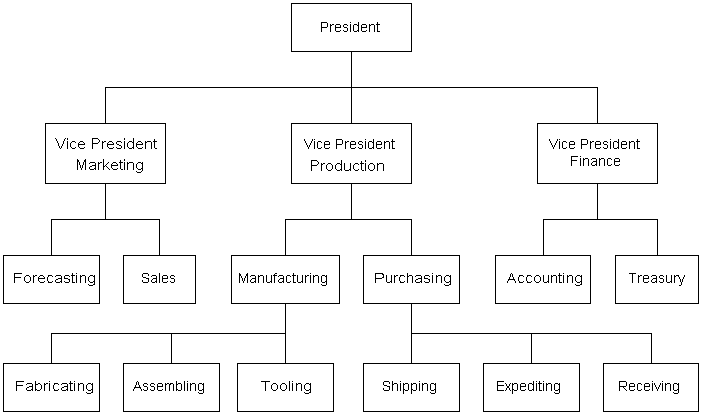
Figure 2-2: Illustrative Hierarchical Structure of Management Functions
The management science and decision support approach contributes to the development of a body of quantitative methods designed to aid managers in making complex decisions related to operations and production. In decision back up systems, emphasis is placed on providing managers with relevant information. In direction science, a cracking deal of attention is given to defining objectives and constraints, and to constructing mathematical analysis models in solving circuitous bug of inventory, materials and production control, among others. A topic of major interest in management science is the maximization of profit, or in the absence of a workable model for the operation of the entire system, the suboptimization of the operations of its components. The optimization or suboptimization is often achieved by the use of operations research techniques, such every bit linear programming, quadratic programming, graph theory, queuing theory and Monte Carlo simulation. In improver to the increasing use of computers accompanied by the development of sophisticated mathematical models and information systems, management science and conclusion support systems have played an of import role by looking more advisedly at trouble inputs and relationships and past promoting goal formulation and measurement of performance. Artificial intelligence has too begun to exist applied to provide decision support systems for solving ill-structured problems in direction.
The behavioral science approach for human resource evolution is important considering management entails getting things done through the deportment of people. An constructive manager must understand the importance of human factors such as needs, drives, motivation, leadership, personality, behavior, and work groups. Within this context, some identify more emphasis on interpersonal beliefs which focuses on the individual and his/her motivations every bit a socio-psychological beingness; others emphasize more group behavior in recognition of the organized enterprise as a social organism, subject to all the attitudes, habits, pressures and conflicts of the cultural environment of people. The major contributions made by the behavioral scientists to the field of management include: (1) the formulation of concepts and explanations most individual and group behavior in the organization, (two) the empirical testing of these concepts methodically in many unlike experimental and field settings, and (3) the institution of actual managerial policies and decisions for functioning based on the conceptual and methodical frameworks.
Sustainable competitive advantage stems primarily from expert management strategy. As Michael Porter of the Harvard Business Schoolhouse argues:
Strategy is creating fit among a company'southward activities. The success of a strategy depends on doing many things well - not merely a few - and integrating amongst them. If at that place is no fit among activites, there is no distinctive strategy and little sustainability.In this view, successful firms must improve and marshal the many processes underway to their strategic vision. Strategic positioning in this fashion requires:
- Creating a unique and valuable position.
- Making merchandise-offs compared to competitors
- Creating a "fit" among a company'due south activities.
2.3 Strategic Planning and Projection Programming
The programming of upper-case letter projects is shaped past the strategic plan of an organization, which is influenced by market demands and resources constraints. The programming process associated with planning and feasibility studies sets the priorities and timing for initiating various projects to meet the overall objectives of the organizations. However, once this conclusion is made to initiate a project, market place pressure may dictate early and timely completion of the facility.
Amidst various types of construction, the influence of market pressure on the timing of initiating a facility is most obvious in industrial structure. [3] Demand for an industrial production may be short-lived, and if a company does not hit the market first, there may not be demand for its production later. With intensive competition for national and international markets, the trend of industrial construction moves toward shorter project life cycles, especially in applied science intensive industries.
In order to gain time, some owners are willing to forego thorough planning and feasibility study then as to keep on a project with inadequate definition of the project scope. Invariably, subsequent changes in project scope will increment construction costs; however, profits derived from earlier facility functioning often justify the increase in construction costs. Generally, if the owner can derive reasonable profits from the operation of a completed facility, the project is considered a success fifty-fifty if structure costs far exceed the estimate based on an inadequate scope definition. This attitude may be attributed in large part to the uncertainties inherent in construction projects. It is hard to fence that profits might be even higher if construction costs could be reduced without increasing the projection duration. Nonetheless, some projects, notably some nuclear power plants, are clearly unsuccessful and abandoned before completion, and their demise must be attributed at least in office to inadequate planning and poor feasibility studies.
The owner or facility sponsor holds the primal to influence the structure costs of a project considering any decision made at the beginning stage of a project life bike has far greater influence than those made at later stages, as shown schematically in Figure ii-3. Moreover, the design and construction decisions will influence the standing operating costs and, in many cases, the revenues over the facility lifetime. Therefore, an possessor should obtain the expertise of professionals to provide adequate planning and feasibility studies. Many owners exercise not maintain an in-house engineering and construction management capability, and they should consider the establishment of an ongoing relationship with outside consultants in club to respond chop-chop to requests. Even among those owners who maintain technology and construction divisions, many treat these divisions as reimbursable, independent organizations. Such an arrangement should not discourage their legitimate use as false economies in reimbursable costs from such divisions tin can indeed exist very costly to the overall organization.

Figure 2-3: Ability to Influence Construction Toll Over Fourth dimension
Finally, the initiation and execution of capital projects places demands on the resources of the owner and the professionals and contractors to be engaged by the owner. For very large projects, it may bid up the price of engineering services also equally the costs of materials and equipment and the contract prices of all types. Consequently, such factors should be taken into consideration in determining the timing of a project.
Example 2-1: Setting priorities for projects
A department store planned to expand its operation by acquiring 20 acres of land in the southeast of a metropolitan area which consists of well established suburbs for heart income families. An architectural/engineering (A/E) firm was engaged to blueprint a shopping center on the 20-acre plot with the department store as its flagship plus a big number of storefronts for tenants. One yr later, the section store owner purchased two,000 acres of farm land in the northwest outskirts of the same metropolitan area and designated xx acres of this state for a shopping center. The A/E house was again engaged to pattern a shopping center at this new location.
The A/E firm was kept completely in the night while the aggregation of the 2,000 acres of land in the northwest quietly took identify. When the plans and specifications for the southeast shopping eye were completed, the owner informed the A/Eastward firm that information technology would not proceed with the construction of the southeast shopping heart for the time being. Instead, the owner urged the A/E firm to produce a new set up of like plans and specifications for the northwest shopping center every bit soon as possible, even at the cede of cost saving measures. When the plans and specifications for the northwest shopping centre were set, the owner immediately authorized its construction. However, it took another three years before the southeast shopping center was finally built.
The reason behind the change of plan was that the owner discovered the availability of the subcontract land in the northwest which could be developed into residential real estate properties for upper middle income families. The immediate construction of the northwest shopping center would make the land development parcels more than attractive to home buyers. Thus, the owner was able to recoup plenty cash flow in three years to construct the southeast shopping center in add-on to financing the construction of the northeast shopping eye, as well as the state development in its vicinity.
While the owner did non want the structure cost of the northwest shopping center to run wild, it evidently was satisfied with the cost judge based on the detailed plans of the southeast shopping center. Thus, the owner had a full general idea of what the construction cost of the northwest shopping heart would exist, and did not wish to wait for a more refined toll estimate until the detailed plans for that center were ready. To the possessor, the timeliness of completing the structure of the northwest shopping center was far more of import than reducing the structure cost in fulfilling its investment objectives.
Example ii-two: Resource Constraints for Mega Projects
Back to topA major trouble with mega projects is the severe strain placed on the environment, especially on the resources in the immediate area of a construction project. "Mega" or "macro" projects involve structure of very large facilities such every bit the Alaska pipeline synthetic in the 1970's or the Panama Canal constructed in the 1900's. The limitations in some or all of the basic elements required for the successful completion of a mega projection include:
- applied science design professionals to provide sufficient manpower to consummate the blueprint within a reasonable time limit.
- construction supervisors with capacity and experience to direct large projects.
- the number of structure workers with proper skills to do the piece of work.
- the market to supply materials in sufficient quantities and of required quality on time.
- the ability of the local infrastructure to back up the large number of workers over an extended menses of time, including housing, transportation and other services.
To compound the trouble, mega projects are often constructed in remote environments away from major population centers and subject to astringent climate atmospheric condition. Consequently, special features of each mega projection must be evaluated carefully.
2.four Effects of Project Risks on Organization
The uncertainty in undertaking a construction projection comes from many sources and often involves many participants in the project. Since each participant tries to minimize its own risk, the conflicts among various participants tin be detrimental to the project. Only the possessor has the ability to moderate such conflicts as it lone holds the primal to risk assignment through proper contractual relations with other participants. Failure to recognize this responsibility by the owner ofttimes leads to undesirable results. In recent years, the concept of "risk sharing/take a chance assignment" contracts has gained acceptance by the federal regime. [4] Since this type of contract acknowledges the responsibilities of the owners, the contract prices are expected to be lower than those in which all risks are assigned to contractors.
In approaching the problem of uncertainty, it is important to recognize that incentives must be provided if any of the participants is expected to have a greater risk. The willingness of a participant to have risks ofttimes reflects the professional competence of that participant as well every bit its propensity to risk. However, club's perception of the potential liabilities of the participant can bear upon the attitude of run a risk-taking for all participants. When a claim is made against i of the participants, it is hard for the public to know whether a fraud has been committed, or but that an accident has occurred.
Risks in structure projects may be classified in a number of ways. [5] One grade of classification is equally follows:
- Socioeconomic factors
- Ecology protection
- Public condom regulation
- Economic instability
- Commutation rate fluctuation
- Organizational relationships
- Contractual relations
- Attitudes of participants
- Communication
- Technological issues
- Design assumptions
- Site conditions
- Construction procedures
- Construction occupational safety
The ecology protection motility has contributed to the incertitude for structure because of the inability to know what will be required and how long information technology will take to obtain approval from the regulatory agencies. The requirements of continued re-evaluation of problems and the lack of definitive criteria which are practical have also resulted in added costs. Public safety regulations have similar effects, which have been most noticeable in the free energy field involving nuclear ability plants and coal mining. The situation has created constantly shifting guidelines for engineers, constructors and owners as projects move through the stages of planning to construction. These moving targets add a meaning new dimension of uncertainty which can make it well-nigh impossible to schedule and complete work at budgeted cost. Economic atmospheric condition of the past decade accept further reinforced the climate of uncertainty with loftier aggrandizement and interest rates. The deregulation of fiscal institutions has likewise generated unanticipated problems related to the financing of construction.
Uncertainty stemming from regulatory agencies, environmental issues and fiscal aspects of structure should be at least mitigated or ideally eliminated. Owners are keenly interested in achieving some form of breakthrough that will lower the costs of projects and mitigate or eliminate lengthy delays. Such breakthroughs are seldom planned. By and large, they happen when the correct conditions exist, such as when innovation is permitted or when a basis for incentive or reward exists. However, there is a long mode to go before a truthful partnership of all parties involved can exist forged.
During periods of economical expansion, major capital expenditures are fabricated by industries and bid up the toll of construction. In order to control costs, some owners attempt to use stock-still price contracts then that the risks of unforeseen contingencies related to an overheated economy are passed on to contractors. Yet, contractors will raise their prices to compensate for the additional risks.
The risks related to organizational relationships may appear to be unnecessary simply are quite real. Strained relationships may develop between various organizations involved in the design/construct process. When problems occur, discussions frequently centre on responsibilities rather than project needs at a fourth dimension when the focus should be on solving the problems. Cooperation and communication between the parties are discouraged for fright of the effects of impending litigation. This barrier to communication results from the ill-conceived notion that uncertainties resulting from technological problems tin be eliminated past advisable contract terms. The net result has been an increase in the costs of constructed facilities.
The risks related to technological bug are familiar to the design/construct professions which have some degree of control over this category. Yet, because of rapid advances in new technologies which present new problems to designers and constructors, technological risk has get greater in many instances. Certain design assumptions which have served the professions well in the past may become obsolete in dealing with new types of facilities which may accept greater complication or scale or both. Site conditions, particularly subsurface conditions which e'er present some caste of dubiousness, can create an even greater degree of doubt for facilities with heretofore unknown characteristics during operation. Considering construction procedures may not have been fully anticipated, the blueprint may have to be modified after construction has begun. An example of facilities which have encountered such uncertainty is the nuclear ability plant, and many owners, designers and contractors have suffered for undertaking such projects.
If each of the problems cited above can crusade incertitude, the combination of such problems is oft regarded by all parties as being out of control and inherently risky. Thus, the effect of liability has taken on major proportions and has influenced the practices of engineers and constructors, who in turn have influenced the deportment of the owners.
Many owners have begun to understand the problems of risks and are seeking to address some of these problems. For case, some owners are turning to those organizations that offering complete capabilities in planning, design, and construction, and tend to avoid breaking the projection into major components to be undertaken individually by specialty participants. Proper coordination throughout the project elapsing and good organizational communication can avert delays and costs resulting from fragmentation of services, even though the components from diverse services are eventually integrated.
Attitudes of cooperation can be readily applied to the private sector, but only in special circumstances can they be applied to the public sector. The ability to deal with complex bug is often precluded in the competitive bidding which is normally required in the public sector. The situation becomes more difficult with the proliferation of regulatory requirements and resulting delays in design and construction while awaiting approvals from authorities officials who exercise non participate in the risks of the project.
Back to top2.v Organization of Project Participants
The top direction of the owner sets the overall policy and selects the appropriate system to take charge of a proposed project. Its policy will dictate how the project life bike is divided amidst organizations and which professionals should be engaged. Decisions by the elevation management of the possessor will besides influence the arrangement to be adopted for project management. In general, in that location are many ways to decompose a projection into stages. The about typical ways are:
- Sequential processing whereby the project is divided into divide stages and each phase is carried out successively in sequence.
- Parallel processing whereby the project is divided into contained parts such that all stages are carried out simultaneously.
- Staggered processing whereby the stages may be overlapping, such as the apply of phased design-construct procedures for fast track operation.
It should be pointed out that some decompositions may piece of work out better than others, depending on the circumstances. In any case, the prevalence of decomposition makes the subsequent integration particularly of import. The disquisitional problems involved in system for project direction are:
- How many organizations are involved?
- What are the relationships amid the organizations?
- When are the various organizations brought into the project?
There are two bones approaches to organize for projection implementation, even though many variations may be as a result of different contractual relationships adopted by the owner and builder. These basic approaches are divided along the following lines:
- Separation of organizations. Numerous organizations serve as consultants or contractors to the possessor, with different organizations handling design and construction functions. Typical examples which involve different degrees of separation are:
- Traditional sequence of blueprint and structure
- Professional construction direction
- Integration of organizations. A single or joint venture consisting of a number of organizations with a single control undertakes both design and construction functions. 2 extremes may exist cited as examples:
- Owner-builder operation in which all work will be handled in business firm by force account.
- Turnkey operation in which all work is contracted to a vendor which is responsible for delivering the completed project
Since construction projects may be managed by a spectrum of participants in a variety of combinations, the organization for the management of such projects may vary from example to instance. On one extreme, each project may be staffed by existing personnel in the functional divisions of the organization on an ad-hoc footing as shown in Figure 2-iv until the project is completed. This organization is referred to as the matrix organisation as each project director must negotiate all resources for the projection from the existing organizational framework. On the other hand, the organization may consist of a pocket-sized key functional staff for the exclusive purpose of supporting various projects, each of which has its functional divisions as shown in Effigy two-five. This decentralized prepare-upwardly is referred to every bit the project oriented organization every bit each project manager has autonomy in managing the project. There are many variations of management fashion between these two extremes, depending on the objectives of the arrangement and the nature of the construction project. For example, a large chemical company with in-business firm staff for planning, design and construction of facilities for new product lines volition naturally prefer the matrix organization. On the other hand, a structure company whose existence depends entirely on the management of certain types of construction projects may find the project-oriented organization specially bonny. While organizations may differ, the same bones principles of management construction are applicable to well-nigh situations.
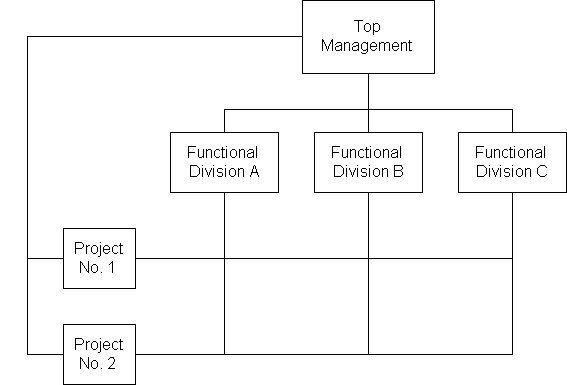
Effigy ii-iv: A Matrix System
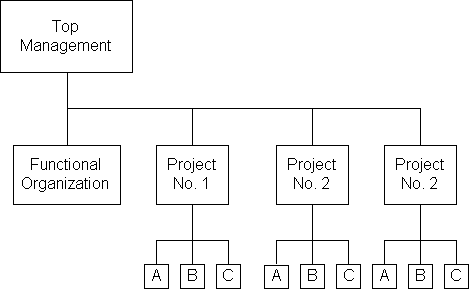
Figure two-v: A Projection-Oriented Arrangement
To illustrate various types of organizations for project management, we shall consider 2 examples, the starting time one representing an owner organization while the 2nd one representing the organization of a construction direction consultant under the direct supervision of the owner.
Example 2-3: Matrix Organization of an Applied science Division
The Engineering Division of an Electric Power and Low-cal Company has functional departments as shown in Figure 2-6. When minor calibration projects such as the addition of a manual tower or a sub-station are authorized, a matrix organization is used to comport out such projects. For example, in the design of a manual tower, the professional person skill of a structural engineer is most important. Consequently, the leader of the projection team will be selected from the Structural Engineering Department while the remaining squad members are selected from all departments every bit dictated by the manpower requirements. On the other paw, in the design of a new sub-station, the professional skill of an electrical engineer is nigh important. Hence, the leader of the projection team will be selected from the Electric Applied science Department.
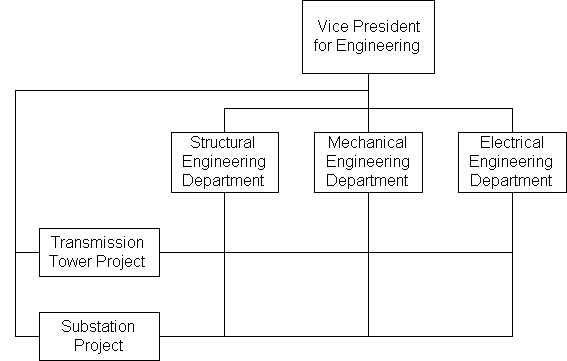
Figure 2-6: The Matrix Organization in an Engineering Division
Case ii-four: Instance of Construction Direction Consultant Organisation
When the same Electric Power and Light Company in the previous case decided to build a new nuclear power plant, information technology engaged a structure management consultant to take charge of the design and construction completely. However, the company likewise assigned a project team to coordinate with the construction management consultant as shown in Figure two-7.
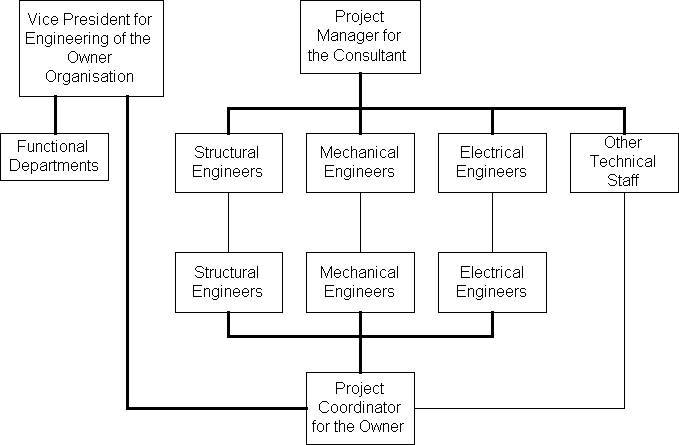
Figure 2-7: Coordination between Owner and Consultant
Back to topSince the company somewhen will operate the ability found upon its completion, it is highly important for its staff to monitor the design and structure of the institute. Such coordination allows the possessor non only to assure the quality of construction but as well to be familiar with the pattern to facilitate time to come functioning and maintenance. Note the close directly relationships of various departments of the possessor and the consultant. Since the project volition last for many years before its completion, the staff members assigned to the project team are non expected to rejoin the Engineering Department only will probably exist involved in the future operation of the new plant. Thus, the projection team can act independently toward its designated mission.
2.6 Traditional Designer-Constructor Sequence
For ordinary projects of moderate size and complexity, the owner oftentimes employs a designer (an architectural/engineering firm) which prepares the detailed plans and specifications for the constructor (a general contractor). The designer also acts on behalf of the possessor to oversee the project implementation during construction. The general contractor is responsible for the construction itself even though the work may really exist undertaken past a number of specialty subcontractors.
The owner usually negotiates the fee for service with the architectural/engineering (A/E) firm. In improver to the responsibilities of designing the facility, the A/E firm besides exercises to some caste supervision of the construction as stipulated past the owner. Traditionally, the A/E business firm regards itself equally design professionals representing the owner who should non communicate with potential contractors to avoid collusion or conflict of interest. Field inspectors working for an A/Due east firm usually follow through the implementation of a project after the design is completed and seldom accept extensive input in the design itself. Considering of the litigation climate in the concluding two decades, most A/East firms only provide observers rather than inspectors in the field. Fifty-fifty the shop drawings of fabrication or construction schemes submitted past the contractors for approval are reviewed with a disclaimer of responsibleness by the A/Eastward firms.
The owner may select a full general constructor either through competitive behest or through negotiation. Public agencies are required to use the competitive bidding style, while individual organizations may choose either mode of operation. In using competitive bidding, the owner is forced to use the designer-constructor sequence since detailed plans and specifications must exist ready before inviting bidders to submit their bids. If the owner chooses to utilise a negotiated contract, it is free to apply phased construction if information technology so desires.
The general contractor may choose to perform all or part of the construction work, or act only equally a director by subcontracting all the construction to subcontractors. The full general contractor may also select the subcontractors through competitive bidding or negotiated contracts. The general contractor may ask a number of subcontractors to quote prices for the subcontracts earlier submitting its bid to the possessor. Nevertheless, the subcontractors frequently cannot force the winning full general contractor to utilize them on the project. This situation may pb to practices known as bid shopping and bid peddling. Bid shopping refers to the situation when the general contractor approaches subcontractors other than those whose quoted prices were used in the winning contract in order to seek lower priced subcontracts. Bid peddling refers to the actions of subcontractors who offering lower priced subcontracts to the winning general subcontractors in order to dislodge the subcontractors who originally quoted prices to the general contractor prior to its bid submittal. In both cases, the quality of construction may exist sacrificed, and some land statutes forbid these practices for public projects.
Although the designer-constructor sequence is yet widely used because of the public perception of fairness in competitive behest, many individual owners recognize the disadvantages of using this approach when the project is large and complex and when market pressures require a shorter projection elapsing than that which can exist accomplished by using this traditional method.
Dorsum to top2.7 Professional person Structure Direction
Professional construction management refers to a project management team consisting of a professional construction manager and other participants who will carry out the tasks of project planning, design and construction in an integrated style. Contractual relationships amongst members of the team are intended to minimize adversarial relationships and contribute to greater response inside the management group. A professional construction manager is a firm specialized in the practice of professional construction management which includes:
- Piece of work with owner and the A/E firms from the start and make recommendations on design improvements, structure technology, schedules and construction economic system.
- Advise design and construction alternatives if advisable, and analyze the effects of the alternatives on the projection cost and schedule.
- Monitor subsequent development of the project in society that these targets are not exceeded without the knowledge of the owner.
- Coordinate procurement of material and equipment and the piece of work of all construction contractors, and monthly payments to contractors, changes, claims and inspection for conforming design requirements.
- Perform other project related services as required by owners.
Professional construction direction is usually used when a project is very large or complex. The organizational features that are characteristics of mega-projects tin exist summarized every bit follows:[6]
- The overall organizational approach for the projection will change as the projection advances. The "functional" organization may change to a "matrix" which may alter to a "project" organization (not necessarily in this order).
- Inside the overall organisation, in that location will probably be functional, project, and matrix suborganizations all at the same time. This feature greatly complicates the theory and the do of direction, yet is essential for overall cost effectiveness.
- Successful behemothic, complex organizations unremarkably have a strong matrix-type suborganization at the level where basic price and schedule command responsibility is assigned. This suborganization is referred to as a "price middle" or as a "project" and is headed by a project manager. The cost center matrix may have participants assigned from many different functional groups. In turn, these functional groups may have technical reporting responsibilities to several dissimilar and college tiers in the system. The key to a cost effective effort is the development of this project suborganization into a single team under the leadership of a strong project manager.
- The extent to which decision-making will be centralized or decentralized is crucial to the organization of the mega-project.
Consequently, it is important to recognize the changing nature of the organizational structure every bit a projection is carried out in diverse stages.
Instance 2-5: Managing of the Alaska Pipeline Project
The Alaska Pipeline Projection was the largest, most expensive private structure project in the 1970'south, which encompassed 800 miles, thousands of employees, and ten billion dollars.
At the planning stage, the possessor (a consortium) employed a Construction Management Contractor (CMC) to direct the pipeline portion, but retained centralized decision making to assure single direction and to integrate the attempt of the CMC with the pump stations and the terminals performed by another contractor. The CMC likewise centralized its conclusion making in directing over 400 subcontractors and thousands of vendors. Considering at that place were 19 different construction camps and hundreds of different construction sites, this centralization acquired delays in decision making.
At about the xv% point of physical completion, the owner decided to reorganize the decision making process and change the role of the CMC. The new organisation was a combination of possessor and CMC personnel assigned within an integrated organization. The objective was to develop a single project squad responsible for controlling all subcontractors. Instead of having nine tiers of organization from the General Director of the CMC to the subcontractors, the new organization had only iv tiers from the Senior Project Manager of the owner to subcontractors. Too unified direction and coordination, this reduction in tiers of organization greatly improved communications and the power to make and implement decisions. The new organization too immune decentralization of decision making by treating five sections of the pipeline at different geographic locations as separate projects, with a section manager responsible for all functions of the department as a turn a profit center.
At most 98% point of physical completion, all remaining activities were to exist consolidated to identify single bottom-line responsibility, to reduce duplication in management staff, and to unify coordination of remaining work. Thus, the projection was first handled by split up organizations just afterward was run by an integrated organisation with decentralized profit centers. Finally, the organization in effect became small and was ready to exist phased out of operation.
Example two-6: Managing the Channel Tunnel Construction from Uk to France
Back to topThe secret railroad tunnel from Great britain to France is unremarkably called the Channel Tunnel or Chunnel. It was built past tunneling from each side. Starting in 1987, the tunnels had a breakthough in 1990.
Management turmoil dogged the project from the beginning. In 1989, seven of the 8 top people in the construction organization left. In that location was a built in conflict between the contractors and regime overseers: "The fundamental thing wrong is that the constractors own less than six% of Eurotunnel. Their involvement is to build and sell the project at a profit. (Eurotunnel'due south) interest is for it to operate economically, safely and reliably for the side by side fifty years." (Alastair Morton, Eurotunnel CEO, quoted in ENR, 12/10/90, p. 56).
2.8 Owner-Architect Functioning
In this arroyo an owner must have a steady flow of on-going projects in order to maintain a large piece of work forcefulness for in-house functioning. All the same, the owner may cull to subcontract a substantial portion of the project to outside consultants and contractors for both design and construction, even though it retains centralized conclusion making to integrate all efforts in project implementation.
Example two-seven: U.S. Army Corps of Engineers Organization
The District Engineer's Office of the U.S. Army Corps of Engineers may exist viewed as a typical example of an possessor-architect approach equally shown in Figure 2-viii.
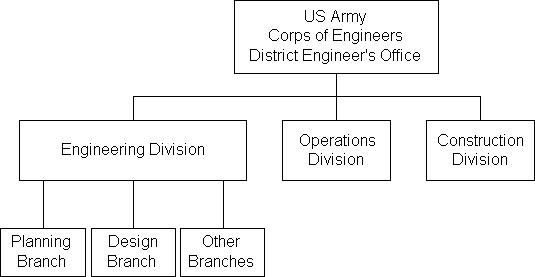
Figure 2-viii: System of a District of Corps of Engineers
Back to topIn the District Engineer'due south Office of the U.Due south. Corps of Engineers, there usually be an Engineering Division and an Operations Division, and, in a large district, a Construction Division. Nether each division, there are several branches. Since the authorization of a projection is ordinarily initiated by the U.Due south. Congress, the planning and design functions are separated in guild to facilitate operations. Since the authority of the feasibility study of a project may precede the authority of the pattern by many years, each phase can all-time exist handled by a dissimilar branch in the Applied science Division. If construction is ultimately authorized, the work may be handled past the Structure Division or past exterior contractors. The Operations Partition handles the operation of locks and other facilities which require routine attending and maintenance.
When a project is authorized, a project director is selected from the most appropriate branch to head the projection, together with a group of staff drawn from various branches to form the project team. When the project is completed, all members of the team including the projection manager will render to their regular posts in diverse branches and divisions until the adjacent project assignment. Thus, a matrix organization is used in managing each projection.
two.9 Turnkey Operation
Some owners wish to delegate all responsibilities of pattern and structure to outside consultants in a turnkey project arrangement. A contractor agrees to provide the completed facility on the basis of performance specifications set forth by the owner. The contractor may fifty-fifty assume the responsibility of operating the project if the possessor and then desires. In order for a turnkey operation to succeed, the owner must be able to provide a set up of unambiguous performance specifications to the contractor and must have complete confidence in the adequacy of the contractor to carry out the mission.
This approach is the direct contrary of the owner-builder approach in which the owner wishes to retain the maximum amount of command for the design-construction process.
Example 2-eight: An Example of a Turnkey Organization
Back to topA 150-Mw power establish was proposed in 1985 by the Texas-New Mexico Power Company of Fort Worth, Texas, which would make use of the turnkey performance. [seven] Upon blessing by the Texas Utility Commission, a consortium consisting of H.B. Zachry Co., Westinghouse Electric Co., and Combustion Engineering, Inc. would design, build and finance the ability plant for completion in 1990 for an estimated construction price of $200 million in 1990 dollars. The consortium would assume total liability during construction, including debt service costs, and thereby eliminate the risks of cost escalation to charge per unit payers, stockholders and the utility company management.
2.10 Leadership and Motivation for the Project Team
The projection manager, in the broadest sense of the term, is the most important person for the success or failure of a projection. The projection manager is responsible for planning, organizing and controlling the project. In turn, the projection manager receives potency from the management of the arrangement to mobilize the necessary resource to complete a project.
The project manager must exist able to exert interpersonal influence in gild to lead the project team. The project manager often gains the back up of his/her team through a combination of the following:
- Formal potency resulting from an official capacity which is empowered to issue orders.
- Reward and/or punishment power resulting from his/her capacity to dispense directly or indirectly valued organization rewards or penalties.
- Adept ability when the project managing director is perceived as possessing special knowledge or expertise for the job.
- Attractive power because the project manager has a personality or other characteristics to convince others.
In a matrix organization, the members of the functional departments may be accustomed to a single reporting line in a hierarchical construction, just the project director coordinates the activities of the squad members drawn from functional departments. The functional construction within the matrix system is responsible for priorities, coordination, assistants and last decisions pertaining to project implementation. Thus, there are potential conflicts between functional divisions and project teams. The project manager must be given the responsibility and authority to resolve various conflicts such that the established project policy and quality standards volition not be jeopardized. When contending bug of a more than primal nature are developed, they must exist brought to the attending of a high level in the management and be resolved expeditiously.
In general, the project manager's authorisation must be clearly documented as well as defined, particularly in a matrix system where the functional segmentation managers often retain certain dominance over the personnel temporarily assigned to a project. The following principles should be observed:
- The interface betwixt the project manager and the functional division managers should exist kept as simple equally possible.
- The project manager must proceeds control over those elements of the project which may overlap with functional division managers.
- The project manager should encourage problem solving rather than role playing of team members drawn from diverse functional divisions.
2.11 Interpersonal Beliefs in Projection Organizations
While a successful project manager must be a good leader, other members of the project team must too larn to piece of work together, whether they are assembled from different divisions of the same organization or even from unlike organizations. Some problems of interaction may arise initially when the team members are unfamiliar with their own roles in the project squad, especially for a large and complex project. These problems must be resolved quickly in club to develop an effective, functioning squad.
Many of the major problems in construction projects require constructive interventions by individuals, groups and organizations. The fundamental challenge is to enhance communication among individuals, groups and organizations so that obstacles in the way of improving interpersonal relations may be removed. Some behavior scientific discipline concepts are helpful in overcoming communication difficulties that cake cooperation and coordination. In very large projects, professional beliefs scientists may be necessary in diagnosing the issues and advising the personnel working on the project. The ability of the organization should be used judiciously in resolving conflicts.
The major symptoms of interpersonal behavior bug can be detected by experienced observers, and they are often the sources of serious advice difficulties amongst participants in a project. For instance, members of a project team may avert each other and withdraw from agile interactions virtually differences that need to be dealt with. They may endeavour to criticize and blame other individuals or groups when things go incorrect. They may resent suggestions for comeback, and get defensive to minimize culpability rather than take the initiative to maximize achievements. All these actions are detrimental to the project organization.
While these symptoms can occur to individuals at any organization, they are compounded if the project team consists of individuals who are put together from different organizations. Invariably, unlike organizations have unlike cultures or modes of operation. Individuals from different groups may non have a common loyalty and may adopt to expand their energy in the directions almost advantageous to themselves instead of the project team. Therefore, no ane should take it for granted that a project team volition work together harmoniously just because its members are placed physically together in one location. On the contrary, it must be assumed that proficient communication tin can be achieved only through the deliberate effort of the acme direction of each arrangement contributing to the joint venture.
Dorsum to toptwo.12 Perceptions of Owners and Contractors
Although owners and contractors may take different perceptions on project management for construction, they have a common interest in creating an environment leading to successful projects in which functioning quality, completion time and final costs are inside prescribed limits and tolerances. It is interesting therefore to note the opinions of some leading contractors and owners who were interviewed in 1984. [viii]
From the responses of 6 contractors, the central factors cited for successful projects are:
- well defined scope
- extensive early planning
- proficient leadership, management and first line supervision
- positive client relationship with client involvement
- proper project team chemistry
- quick response to changes
- applied science managers concerned with the full project, not simply the engineering elements.
Conversely, the key factors cited for unsuccessful projects are:
- ill-defined telescopic
- poor management
- poor planning
- breakup in communication betwixt engineering and construction
- unrealistic telescopic, schedules and budgets
- many changes at various stages of progress
- lack of proficient project control
The responses of eight owners indicated that they did non always understand the concerns of the contractors although they generally agreed with some of the key factors for successful and unsuccessful projects cited by the contractors. The meaning findings of the interviews with owners are summarized as follows:
- All owners have the same perception of their ain function, but they differ significantly in assuming that role in practice.
- The owners also differ dramatically in the amount of early planning and in providing data in bid packages.
- There is a trend toward breaking a project into several smaller projects equally the projects become larger and more circuitous.
- Near owners recognize the importance of schedule, but they adopt different requirements in decision-making the schedule.
- All concur that people are the key to project success.
From the results of these interviews, it is obvious that owners must be more aware and involved in the process in order to generate favorable weather condition for successful projects. Design professionals and structure contractors must provide better communication with each other and with the owner in project implementation.
Back to pinnacletwo.13 References
- Barrie, Donald S. and Boyd C. Paulson, Jr., Professional Construction Management, McGraw-Colina Book Company, 2nd Ed., 1984.
- Halpin, Daniel West. and Ronald W. Woodhead, Construction Management, John Wiley and Sons, 1980.
- Hodgetts, R.M., Management: Theory, Process and Do, W.B. Saunders Co., Philadelphia, PA, 1979.
- Kerzner, H. Project Management: A Systems Arroyo to Planning, Scheduling and Controlling. 2nd. Ed., Van Nostrand Reinhold, New York, 1984.
- Levitt, R.E., R.D. Logcher and N.H. Quaddumi, "Affect of Owner-Engineer Take chances Sharing on Design Conservatism," ASCE Journal of Professional person Problems in Engineering science, Vol. 110, 1984, pp. 157-167.
- Moolin, F.P., Jr., and F.A. McCoy: "Managing the Alaska Pipeline Project," Civil Engineering, November 1981, pp. 51-54.
- Murray, 50., Due east. Gallardo, S. Aggarwal and R. Waywitka, "Marketing Construction Direction Services," ASCE Periodical of Construction Division, Vol. 107, 1981, pp. 665-677.
- Project Management Institute, A Guide to the Project Management Body of Knowledge, Newtown Square, Pennsylvania, 2000.
ii.14 Footnotes
- See R. M. Wideman, "The PMBOK Report -- PMI Body of Noesis Standard," Project Management Periodical, Vol. 17, No. three, August l986, pp. l5-24. Back
- See L. C. Stuckenbruck, "Project Management Framework," Project Management Journal, Vol. 17, No. iii, August 1986, pp. 25-thirty. Back
- Run across, for instance, O'Connor, J.T., and Vickory, C.G., Control of Construction Project Scope, A Report to the Construction Manufacture Found, The University of Texas at Austin, Dec 1985. Back
- See, for example, Federal Form 23-A and EPA's Appendix C-ii clauses. Dorsum
- See East. D'Appolonia, "Coping with Uncertainty in Geotechnical Engineering and Construction," Special Proceedings of the 9th International Conference on Soil Mechanics and Foundation Engineering, Tokyo, Nippon, Vol. 4, 1979, pp. ane-18. Back
- These features and the following example are described in F.P. Moolin, Jr. and F.A. McCoy, "Managing the Alaska Pipeline Project," Ceremonious Engineering, November 1981, pp. 51-54. Dorsum
- "Private Money Finances Texas Utility's Power Institute" Technology News Record: July 25, 1985, p. 13. Back
- See J.E. Diekmann and M.B. Thrush, Project Control in Design Technology, A Study to the Construction Industry Institute, The University of Texas at Austin, Texas, May 1986. Back
| Previous Affiliate | | | Tabular array of Contents | | | Side by side Affiliate |
Source: https://www.cmu.edu/cee/projects/PMbook/02_Organizing_For_Project_Management.html
0 Response to "What Kind of Management Personnel Do You Need to Start a Construction Company"
Post a Comment